
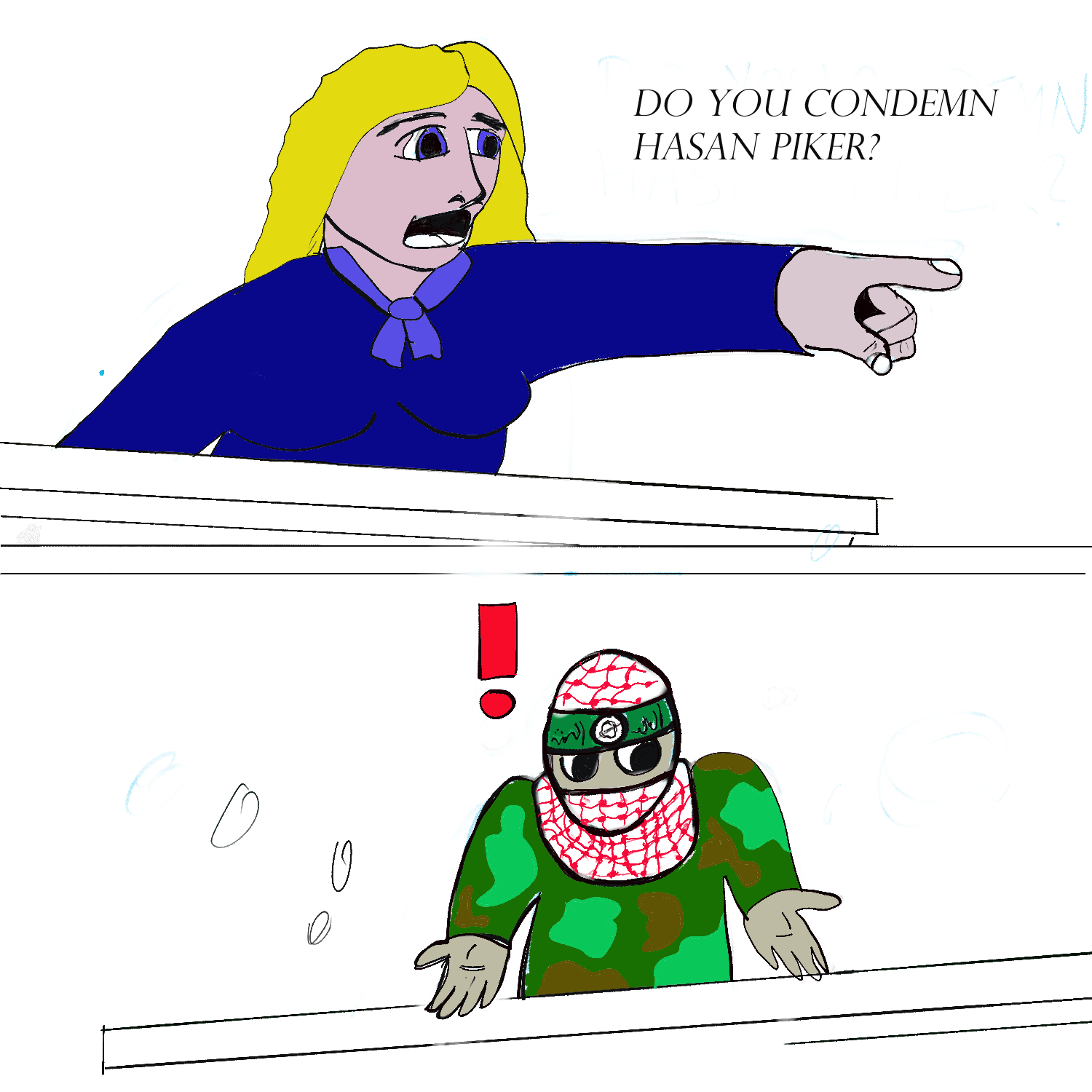
I’ll open this post with another of my wife’s cartoons she made, admittedly, a few weeks ago. Not only do I enjoy supporting her artistic endeavors, but I can tell a degree of her making cartoons is an effort to inspire me to return to my own cartoon practice. Maybe I’ll comment on that later…
My wife and I are both avid Hasan Piker fans – so, you know, antisemitic terrorists that hate America (I mean, that last part is right). I have a hard time believing that somebody who reads this blog wouldn’t know who Hasan is, but if you don’t, Hasan is a Twitch streamer who comments on politics from a “Left” perspective, and he has recently become the #1 scapegoat in the crosshairs of American media and politics, due to his advocating for the rights of Palestinians to his large audience – hence the smear against Hasan and anyone who watches him as being “antisemitic”. For the last few weeks, everywhere you look on American news has been daily obsessive condemnations of Hasan and hyper-fixations on every statement he makes, all spun in the least charitable way possible – with him recently apparently being subpoenaed by the US government. In a testament to just how far popular opinion has shifted in favor of the Palestinians, the efforts to toxify Hasan’s name have largely backfired, and multiple political candidates backed by Hasan who espouse policies like those he professes on-stream have experienced significant bumps in popularity due to their associating with Hasan and the amplification of their visibility by the media’s fixation on him. The obsession has gone so far that, in routine Zionist fashion, literal, actual neo-nazis and far right figures who speak literal, actual antisemitism are framed by the media and organizations like the Anti-Defamation League as being less of a danger than the man who advocates for an end to genocide, and for a formation of a truly democratic society in the Levant, with equal rights for all people living there. Not to make too much out of a media figure, but they do this because a popular figure who espouses such views to a large audience is more of a danger to both settler-colonialism and capitalism in Israel and the West, than an actual nazi could ever be.
Hasan was actually talking on stream the other day about how in 2016, after Donald Trump was elected the first time, people were so hopeless and scared and didn’t know what to do to effect actual change in the real world, that they turned inward and began the “Golden Age of Woke”, where the primary vector of political and cultural criticism became that of media. While the media criticism tweet thread or video essay were both well-established art-forms before 2016, they truly took off as people increasingly felt the need for change to the social order, but didn’t see any option for real change as long as ” that Orange-Cheetoh-Hitler-Palpatine in the White House” seemingly held all the cards. TV shows, movies, and video games were obsessively dissected and critiqued for their success or failure at intersectionality in writing and casting. A person’s true character would be revealed by their media consumption, and cancellation of TV shows began to extend to cancellation of people, and the hen-pecking/crab bucketing of our peers over social media joined our scapegoating of traditional media to placate our impotent rage against oppression. After 2020 turned more and more people even further inward still, and the major sources of entertainment for most people became streamers and content creators on video platforms, this pattern is playing out again 10 years later; it’s 2026, Donald Trump is president again, people feel even more hopeless now, and they are turning to obsessively criticizing their new primary modes of entertainment: streamers and social media personalities.
My wife said something to me the other day as we were discussing the dramatic ups and downs of American politics, and I mused if whether they weren’t being scripted to some degree, to lead people by their emotions from one place to another, paralyzing them and preventing them from acting to effect real change.
She said “No. I think Americans ARE television. Their politics looks like a TV show because all anyone does is watch TV and talk about TV, and so their culture is TV, so they are TV, and so their politicians are TV.”
Our worldview shapes which actions we believe are available to us, and we act out the narratives laid out for us by our cultural frameworks. If all you do is watch TV and movies and consume “reality” processed through the distorting lens of media, you might think that what you see on the screen is the only way for a person to look and act. How distorted is most people’s body image by advertising? What erroneous beliefs do people pick up from the news about those different from them? How are our views about what makes a “real” man or woman shaped by stories supposedly about people’s lives? What do we think “success” looks like, based on images presented to us by corporations that just so happen to also be trying to sell us things? What actions do we believe are available to us, based on what is presented as “legitimate protest” by the “legitimate authorities”?
Whether or not it is some intentional conspiracy to control us, or a selection process of competing media strategies by various self-interested actors vying for influence in a marketplace, I do think we in the West have, to varying degrees, all become TV in how we see and understand the world. And I do think our time honored practice of yelling at the jackass on TV we disagree with has fully invaded our social lives in the real world, as well. I have noticed in recent years that people are far more likely to jump to conclusions, have extreme reactions to things, and to write other people off, including their friends, at the drop of a hat. And now as more and more people make a living as “content creators”, the invasion and suffusion is total. I had a conflict with a friend the other day over text, and while we were still in the middle of hashing it out, I saw her posting videos on her timeline referencing it (without naming me). Like, girl, could you at least wait for the situation to conclude before you start cutting content about it? (Now it’s fair – you cut 1 content, I cut 1 content). We worked it out, it’s chill. But it frequently isn’t, and the friend breakups of today frequently take the form of timeline crashouts and call-out videos. How many of these conflicts are wholly unnecessary, and are spurred on by our modelling of behaviors found in toxic media tropes? We act in the ways we have learned it is appropriate to act, and increasingly that has been shaped by people who live their entire lives performing every interaction in front of an audience.
I’ve been in this line of work in “online media” for 11 years at this point. I’ve experienced many different upturns in my relatively modest popularity, almost always tied to a comic or post of mine that “went viral”. With those upturns in notoriety, always came an upswing in hatred and harassment, pretty much always transphobic in nature – any point of vulnerability you possess will be seized upon by the angry mob looking to offload their frustration onto somebody. I’ve had whole forums on wretched places like Kiwi Farms dedicated to stalking and harassing me – never to the extent that many others I know have received, but I’ve certainly weathered my share of hate storms and comment raids.
In my experience, the things that go viral are never something that you put a lot of effort into. They’re not some expression of artistic passion, nor are they a good example of what the poster really cares about or is interested in. They are typically simple, inflammatory, and surprising. They need to be easily digestible by broad cross-sections of people, they need to provoke some kind of emotional response – positive or negative – and they need to catch the audience off-guard in a way that makes them think in that moment “I need to share this”. The comics and art I have put the most effort into and felt was my strongest work will often be outperformed by the ones I don’t care much about or put much effort into. All that matters is that a post hit those three things, and it will be shared widely, regardless of its overall quality otherwise.
Much of my own past few weeks have been dominated by the stupidest, most low effort thing I’ve ever made going more viral than almost anything else I’ve made, bringing with it a much larger hate storm than I’ve experienced in many years.
Anyone who knows me or who reads this blog knows I have turned my lifelong love of martial arts and my dedication to community work to starting up my free Karate classes in the Vancouver area for LGBTQ people. Our club has become extremely vibrant in recent months, almost entirely due to the grassroots organizing in the real world of my incredible volunteer event organizers. We do have some students who have arrived to us via our social media presence, but the vast majority have come from real world connections, which I think is great. But having an online presence is an important part of building up an organization and showing prospective students and partnerships that you are serious and that you have some force of community behind you, so I’ve taken it upon myself to make content advertising our club on my Instagram – a platform I haven’t really used much throughout my online career. Instagram seemed safe for our little club as it was my smallest platform where the baggage of my comics career wasn’t very present.
A few months ago I slapped together a less than 10 second long meme video made from a clip from the 2006 comedy film, “Foot Fist Way“, starring Danny McBride.
Unwittingly, I have unleashed hell upon myself by insulting insecure men’s emotional support martial art, while hitting those three metrics of viral-bility. I mean, *I * didn’t say anything at all. The character played by actor/comedian Danny McBride said that jujutsu sucked. The point of the scene is that he is an intellectually lazy charlatan who only cares about convincing this young woman to join his shitty Taekwondo school. At the time of the film’s making, jujutsu was ascendant in MMA, while Taekwondo was a joke in the combat sports community due to non-contact sport sparring and low standards for giving out black belts. The joke is that this woman would be better off taking jujutsu. Today, 20 years later, jujutsu is losing effectiveness in MMA, as fighters figure out how to counter groundwork by standing up and punching, while Karate and Taekwondo are both enjoying full-contact revivals. You definitely need to engage with the reality of ground game if you want to be an effective fighter today, but gone are the days where just knowing some BJJ was enough to dominate.
But that’s beside the point. Many of these so-called martial arts fans have apparently never seen this movie, and the caricature of trans women they hold in their minds causes them to immediately assume that I am, in fact, Danny McBride, and that’s literally me in the video saying that jujutsu sucks – as though a visit to my profile wouldn’t show them endless videos with my face in them.
I made the video because it seemed funny. It was posted to a small account, and I didn’t think it would go anywhere. It was pretty much just for fun.
WRONG.
NO.
BAD!
CLEARLY I made it to insult the universally superior martial art that is Brazilian Jiuitsu. CLEARLY I wanted it to go viral by being shared by legions of angry men typing slurs at me. And CLEARLY this video is a total representation of what I do on this Earth and what I care about in life.
There was some brief concern by the venue that hosts our class that this hate might carry over to them, and possibly result in some real world harassment or danger, but so far all anyone seems content to do is write a mean comment or message directly at me and then move on. All we are now is yell at TV, or in this case, phone.
While the video continues to attract a lot of hate, it also just generally boosts my Instagram in the algorithm, and numerous people who come for the viral clip, stay for the real martial arts content I post. So it’s not all bad. But it is frustrating. Why can’t the things that I actually care about and try at receive attention and success?
I will admit, this sort of thing actually does demotivate me from making art and especially returning to comics. There are times where I feel like I hate comics, and the very idea of drawing a comic makes me feel angry. But I also know that there is a core of me that truly wants to return. I still have a spark of playfulness inside me, and I do still love to tell stories. I will freely admit that I believe I’m just emotionally blocked – there is something inside me that is preventing me from engaging with the vulnerability required to tell stories about real, fleshed out characters. I feel alienated from humanity – because of the state of the world, because of events like this stupid viral video, because of being trans and carrying anger about gender from a young age – but to truly tell a story requires that you have some connection to the shared humanity of all people. Doing things like volunteering and teaching my karate class and sharing my other art with people are all helping me reconnect with genuine love for my fellow human beings.
I still believe that I will return to telling stories.

